about
News
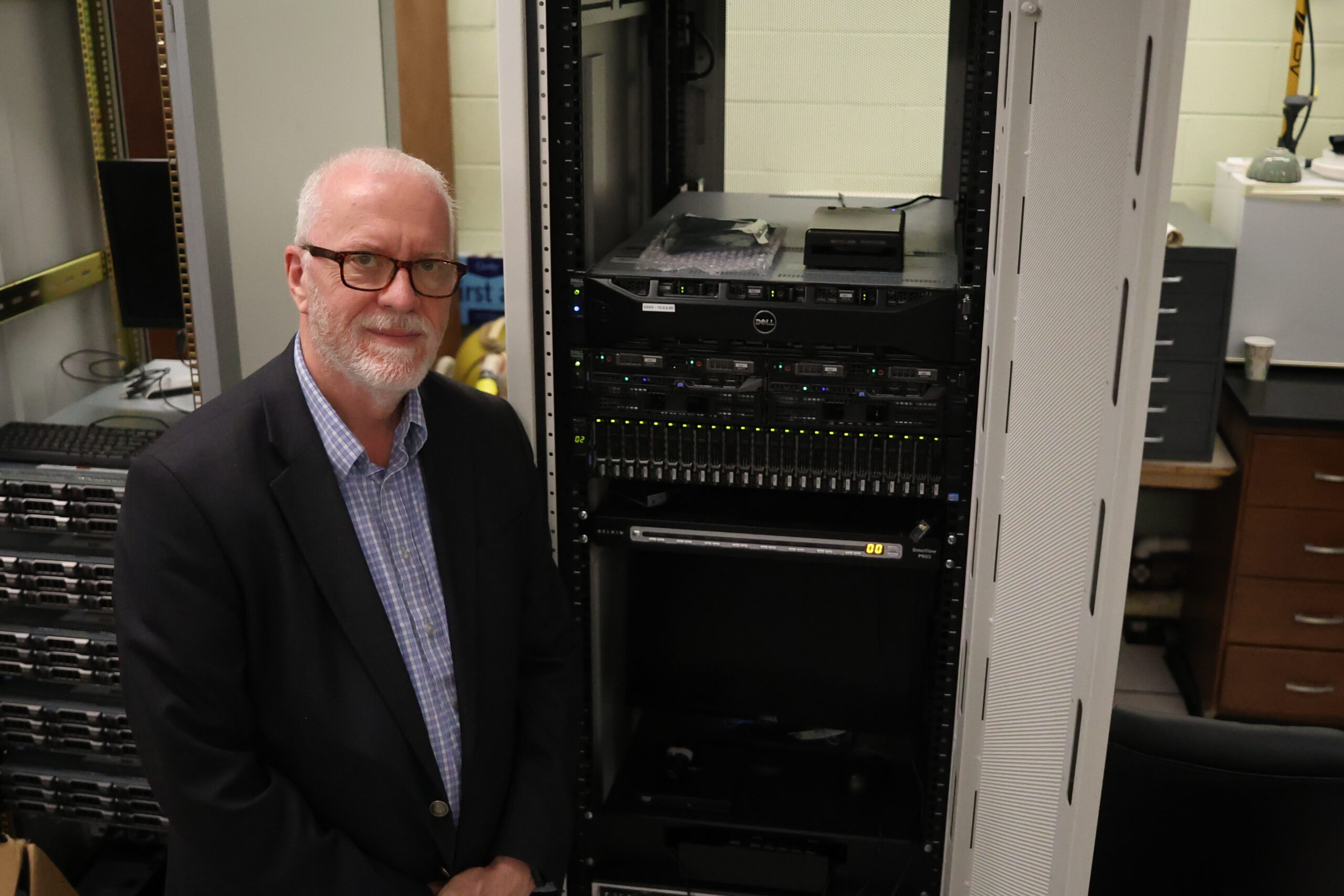
BUCKHANNON, West Virginia — After more than four decades of technological innovation, problem-solving and dedication to students, faculty and staff, Chief Information Officer Neil Roth ’88 will retire from West Virginia Wesleyan College on June 30, concluding a remarkable nearly 43-year career that helped transform the institution from the age of mainframe computers to the beginning of artificial intelligence.
Originally from Buckhannon, West Virginia, Roth began his full-time career at WVWC on July 1, 1984, as a computer engineer in what was then known as the Computer Center. At the time, personal computers were virtually nonexistent on campus, and the College relied on two Digital Equipment Corporation mainframe-type systems to support student and administrative computing.
“I was responsible for maintaining all systems and equipment not covered under maintenance contracts, as well as designing and constructing custom hardware interfaces for the equipment,” he said.
During the early 1980s when he was a part-time employee and student, the College operated two DEC PDP systems – the PDP 11/34 and the PDP 11/70, which provided data services to Wesleyan and Alderson Broaddus College. Shortly before he was hired as a full-time employee, the College transitioned to a DEC VAX 11/750 and a VAX 8300. The first computer lab on campus was in Christopher Hall of Science.
Over the course of his career, Roth played a pivotal role in nearly every major technology advancement at the College. He helped lead the transition from mainframe-type computers to personal computers, trained faculty and staff as new technologies emerged, helped establish some of the College’s first microcomputer labs on campus in the library and the business department and supported the implementation of one of the earliest campus telephone systems in the region.
In 1985, WVWC became its own telephone company through the installation of a NEC NEAX 2400 telephone system, one of the largest systems of its kind in the country at the time. The College implemented direct-dial telephone service prior to the City of Buckhannon, which upgraded its system in 1989.
In 1993, Roth designed and built a telephone-based course registration system device that allowed students to register for classes directly from their residence hall rooms, eliminating the need to wait in long registration lines. At the time, many colleges were only beginning to explore the concept.
He also developed Wesleyan’s first voicemail system and helped bring fiber-optic connectivity to campus. In the mid-1990s, Roth spearheaded the campus-wide fiber-optic and data network installation project.
Roth designed the original campus Main Distribution Frame and Intermediate Distribution Frame drawings, which were later presented to Xitech Corporation in Pittsburgh for final engineering and installation. Around June 1995, the College completed the installation of the project.
“The foundational infrastructure developed during that project continues to support the campus today,” Roth noted.
Throughout his career, Roth’s responsibilities expanded from maintaining computer hardware and telecommunications systems to overseeing enterprise technology operations. He served as engineer for WVWC-FM, assisted with countless technology initiatives and upgrades, became assistant director of Computing Services, and in 2014 accepted the position of Director of Computing Services before later serving as the College’s Chief Information Officer.
Early in his career, Roth assumed responsibility for maintaining and supporting the historic Carillon Chimes system on campus and has made sure the chimes toll daily and for special events. From hymns to more fun pieces for May the Fourth Be With You Day, the chimes are a part of campus culture.
Beyond campus technology, Roth was recognized by then-Governor Joe Manchin for his assistance during the 2006 Sago Mine disaster, when West Virginia Wesleyan College served as a hub for hearings, media coverage and community response efforts. Roth coordinated the technology infrastructure that supported national news organizations and government officials during the crisis.
Despite opportunities elsewhere, Roth chose to remain at Wesleyan.
“I stayed because I believed in this school and the people here,” he said. “I wanted to give it everything I had because I’ve always felt it was a truly special place.”
Asked what has made his time at Wesleyan meaningful, Roth pointed to the people.
“One of the greatest privileges of my career has been getting to know our students and working alongside them,” he said. “Being able to make them smile and, hopefully, make a positive difference in their lives has always been incredibly rewarding. That has always been one of the most meaningful parts of my work. ”
He also emphasized the importance of cybersecurity, an area that has become increasingly critical to higher education institutions.
He credited President James Moore for supporting investments that have helped the College achieve exceptionally strong cybersecurity assessments.
As he prepares to retire, Roth plans to spend more time pursuing music composition, amateur radio, hiking and other personal interests.
Still, leaving the institution he has served for more than four decades will not be easy.
“I’ve spent most of my life here,” Roth said. “When you’ve been part of a place for that many years, it becomes a significant part of who you are.”
After nearly 43 years of service, innovation and dedication, Roth leaves behind a legacy woven into nearly every aspect of the College’s technological evolution. From the first computer labs and campus phone systems to fiber-optic networks, cybersecurity and artificial intelligence, his work has helped shape the Wesleyan experience for generations of students.
“Technology will continue to evolve,” Roth said. “My hope is that, as the College moves forward, people will continue to honor its rich history while preserving the reputation and values that so many have worked tirelessly to build. ”
ABOUT WEST VIRGINIA WESLEYAN COLLEGE
West Virginia Wesleyan College (WVWC) is a private, four-year residential liberal arts and sciences college in Buckhannon, West Virginia. A tradition of excellence for 135 years, West Virginia Wesleyan is home to 14 Fulbright Scholars. The Princeton Review ranked Wesleyan as one of its 2026 Best Colleges in the Mid-Atlantic Region of the United States. U.S. News & World Report’s 2026 Best College Rankings designated Wesleyan second in Best Value – Regional Universities (South). WVWC offers students nearly 60 majors and 40 minors; graduate programs in athletic training, business administration, creative writing, nursing and counseling; 22 NCAA Division II athletic programs; multiple performing arts groups; and more than 50 organizations. Founded in 1890, the College is closely affiliated with the United Methodist Church and abides by the Wesley doctrine that emphasizes service to others. For more information, visit wvwc.edu.