about
News
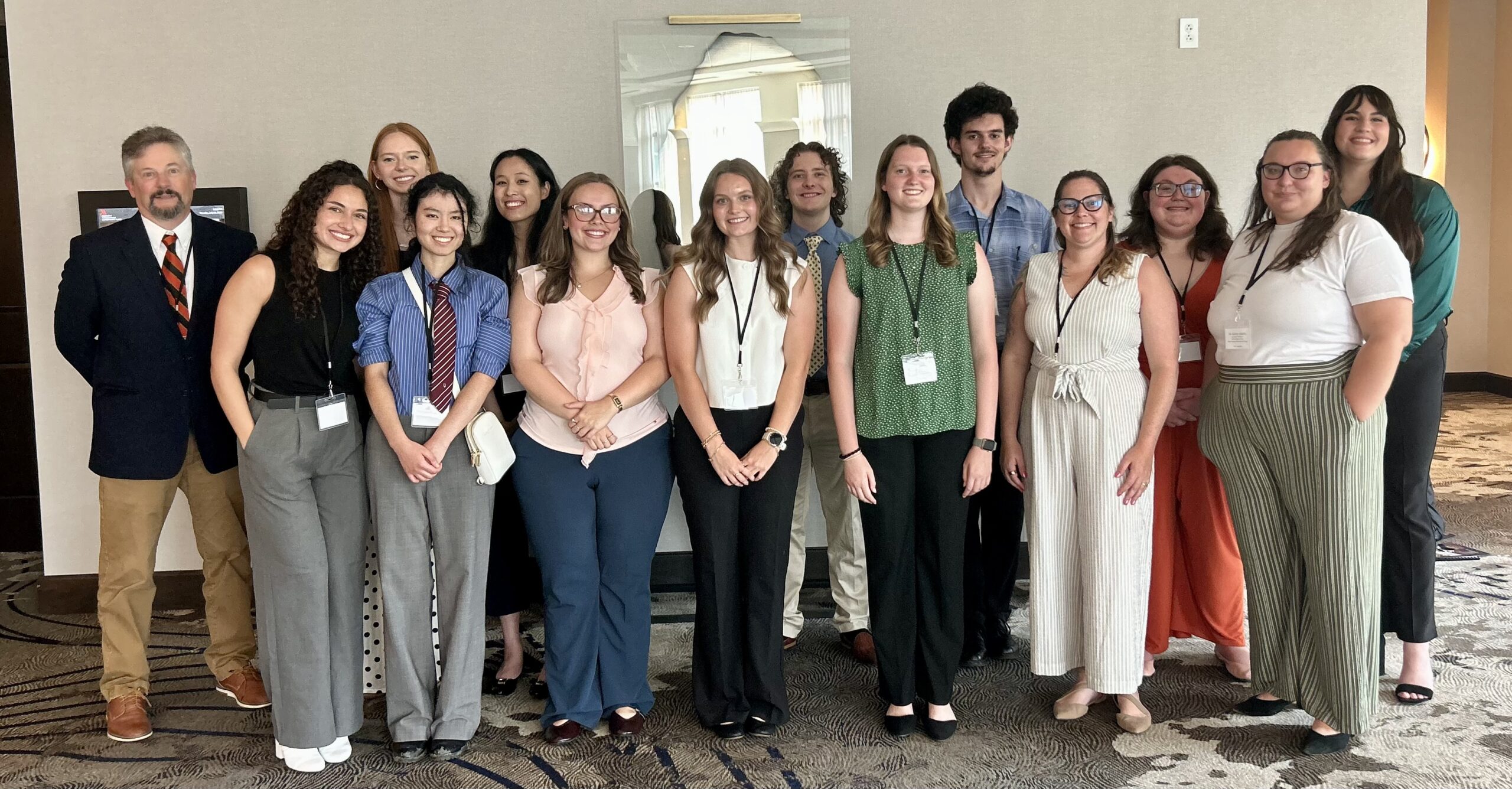
BUCKHANNON, West Virginia – Students from across several science disciplines at West Virginia Wesleyan College spent their summers in the lab and classroom, culminating in final projects presented at 24th Annual Summer Research Symposium in Morgantown. The symposium is hosted by the West Virginia IDeA Network of Biomedical Research Excellence.
Breanna Waldron ’28, from Fairmont, West Virginia, was one of three WV-INBRE interns selected to present at the symposium.
Waldron’s research, “Sensitizing BRCA-Proficient Triple-Negative Breast Cancer Brain Metastasis to PARP Inhibition through Arginine Deprivation” at WVU was supported by a National Institute of Health Grant to the West Virginia IdeA Network for Biomedical Research Excellence.
“This summer, I did research on breast cancer brain metastasis treatments, focusing specifically on implementing arginine deprivation for Triple Negative Breast Cancer cells to make them homologous repair deficient and therefore more sensitive to PARP inhibitor drugs,” Waldron said. “This research project and the WV-INBRE experience as a whole has made me much more knowledgeable about being independent in a lab setting, as well as the importance of research for the field of medicine. Research like this contributes to what medical personnel will hopefully be implementing in the future.”
“As someone who wants to go to medical school, it was great to see how certain medications and treatments are first experimented with to be eventually given in a clinical setting.”
In her research, Waldron worked closely with Olivia Carpenter-Milam ‘23.
Dane Heath ’28, of Buckhannon, West Virginia, is a biochemistry major and mathematics minor, working under the McCuskey Fellowship here at WVWC.
“For my summer research project, my research group worked with Dr. Huggins on a long-term project to look into the effects of ganoderic acids (extracted from Reishi mushrooms) on breast cancer cell lines, hoping to slow the cancers’ metastases,” Heath said. “From an academic standpoint, I learned a lot about how to perform biochemical assay techniques and interpret their results, as well as how to construct a research poster and presentation, which will definitely help with future research projects as well as any similar lab work. More generally, I gained a better understanding of how to effectively coordinate and communicate with my lab partners, especially over such a long period of time.
“I’m looking forward to returning to work with Dr. Huggins next year, helping to guide any newcomers to the project just as I was guided by a more experienced lab mate this past summer, and further developing my team and leadership skills.”
The group’s poster, “The Effect of Ganoderic Acids from Reishi Mushroom on Cell Proliferation, Migration and Matrix Metalloproteinases in Breast Cancer,” also included work by Madelyn Armstrong, Barrett McCain, Lanna Nguyen, Megan Brozik, Caden Carpenter, Colten Workman and Huggins.
The following also presented posters at the symposium:
Mariam Al-Zoubi, Plasma-Derived Large Extracellular Vesicles Promote Cerebrovascular Endothelial Dysfunction in IBD; Christopher Bender, Kaempferol Reduces Cytotoxicity of Hyrdrogen Peroxide and Cisplatin in Renal Proximal Tubular Cells and Ferroptosis Pathway and Pterostilbene Attenuation of Hydrogen Peroxide Cyptotoxity in Human Renal Proximal Tuular Epithelial Cells; Claire Denning, Defining Adolescent Tripartite Synapse Maturation Using Integrated Spatial Transcriptomics and Stimulated Emission Depletion (STED Microscopy); Jannah Miller, Rafe Riley and Dr. Kelsey A. Aldrich, Effects of Macromolecular Crowding on the Kinetics of Pyruvate Kinase Muscle 1 with Variable ADP and PEP Substrates; Addison Taylor, Mary Genes and Aldrich, Pyruvate Kinase L is Sensitive to Physiological Macromolecule Concentrations; Taryn G. Veltri, Sex-Specific Cognitive Effects of Prenatal Nano-TiO2 Exposure and Preventative Febuxostat Treatment; Claire Wheeler, Determining Gene Expression Changes Induced by Ganoderic Acid A in Estrogen Receptor Positive and Estrogen Receptor Negative Human Breast Cancer Cells.
Hope Lima ’12, Associate Professor and Department Chair at Winthrop University, spoke at the career panel.