

Education
Colleges and Programs of Study
Learn to Teach by Teaching
At WV Wesleyan, our education program aims to bridge gaps between educational theories and classroom realities. You will study best practices for teaching and learning and also get hands-on opportunities through guided field experiences in public schools with support from faculty who know you by name.
Why Choose WV Wesleyan Education?
EARLY AND ONGOING CLASSROOM EXPERIENCE
Here, you can gain experience in real classrooms with certified, accomplished teachers and diverse student populations, starting early in your program.
PERSONALIZED FACULTY MENTORSHIP
Here, you can belong to small, interactive classes; this means you have direct access to faculty whose primary focus is teaching, advising, and furthering your professional growth.
PREPARED FOR DAY ONE
Here, you can graduate with confidence and classroom-ready skills to lead, instruct, and adapt for your first day on the job.
The Wesleyan Way
Rooted in WV Wesleyan’s core values, our program goes beyond pedagogy. You will develop a strong appreciation for cultural richness, equity, and respect for every learner; these are essential dispositions for educators in today’s schools.
Our graduates are not just teachers. They are reflective professionals, active learners, and thoughtful decision-makers who are ready to meaningfully impact their classrooms and communities.
West Virginia High School students interested in the Grow Your Own Initiative can Click Here

-
Teacher Education Vision
WVWC Education Vision Statement
Prepare knowledgeable and innovative educators committed to serving diverse learners and improving P-12 student outcomes.
-
Teacher Education Mission
WVWC Education Mission Statement
West Virginia Wesleyan College seeks to recruit and prepare graduates who are knowledgeable of lessons from the past, aware of demands of the present, and prepared to creatively face the challenges of a changing global community. Wesleyan seeks to assist teacher candidates to identify career goals and to develop a broad background in the knowledge, skills, and dispositions necessary to become successful classroom teachers.
Upon completion of the teacher education program, candidates will be knowledgeable in all aspects of teaching and demonstrate the effective use of active learning in the classroom. Candidates will consciously make effective empirical and data based classroom decisions, reflect upon their impact, and modify instruction and practice for the future. Successful candidates will demonstrate the ability to adapt instruction to the cultural and social contexts of the school community and provide for individual differences and diversity.
Candidates must be able to design instruction and learning activities based upon contemporary research, theories, and best practice. Personal, ethical , and professional roles of teachers are identified and nurtured through coursework and experiences. Candidates must possess the personal dispositions necessary to be successful teachers – initiative, responsibility, emotional maturity, being a positive role model, a sincere concern for students, ability to collaborate with colleagues, professional commitment, and reflective evaluation of one’s own dispositions and decisions.
Technological, pedagogical, and content knowledge are prerequisites for teaching. Through a comprehensive study in one’s teaching field, the development of effective teaching strategies, and the desire to exhibit recognized qualities of a professional, the candidate becomes a viable practitioner.
-
Accreditation
The School of Education at WV Wesleyan College was granted Probationary Accreditation at the initial-licensure level by the Accreditation Council of the Council for the Accreditation of Educator Preparation (CAEP) on November 17, 2025.
The following are the CAEP measures and data that provide supporting evidence for each measure:
1. Measure 1 Completer Effectiveness CAEP R4.1
WV Wesleyan College School of Education acknowledges that current CAEP Measure 1 instruments are not fully capturing “completer effectiveness” as defined by CAEP. To address this gap, we are establishing a dedicated focus group in Summer 2026 to gather qualitative and quantitative data specifically focused on the impact our graduates have on P-12 student learning and development. This proactive approach will provide the nuanced evidence of professional impact and teacher effectiveness required to meet CAEP’s reporting standards.
According to CAEP, completers are identified as individuals who have “successfully satisfied all program requirements of a preparation program at least six months previously and who [are] employed in a position for which they were prepared for state licensure.”
Spreadsheet for Final Observation Tool
2. Measure 2 Satisfaction of Employers and Stakeholder Involvement CAEP R4.2, R5.3
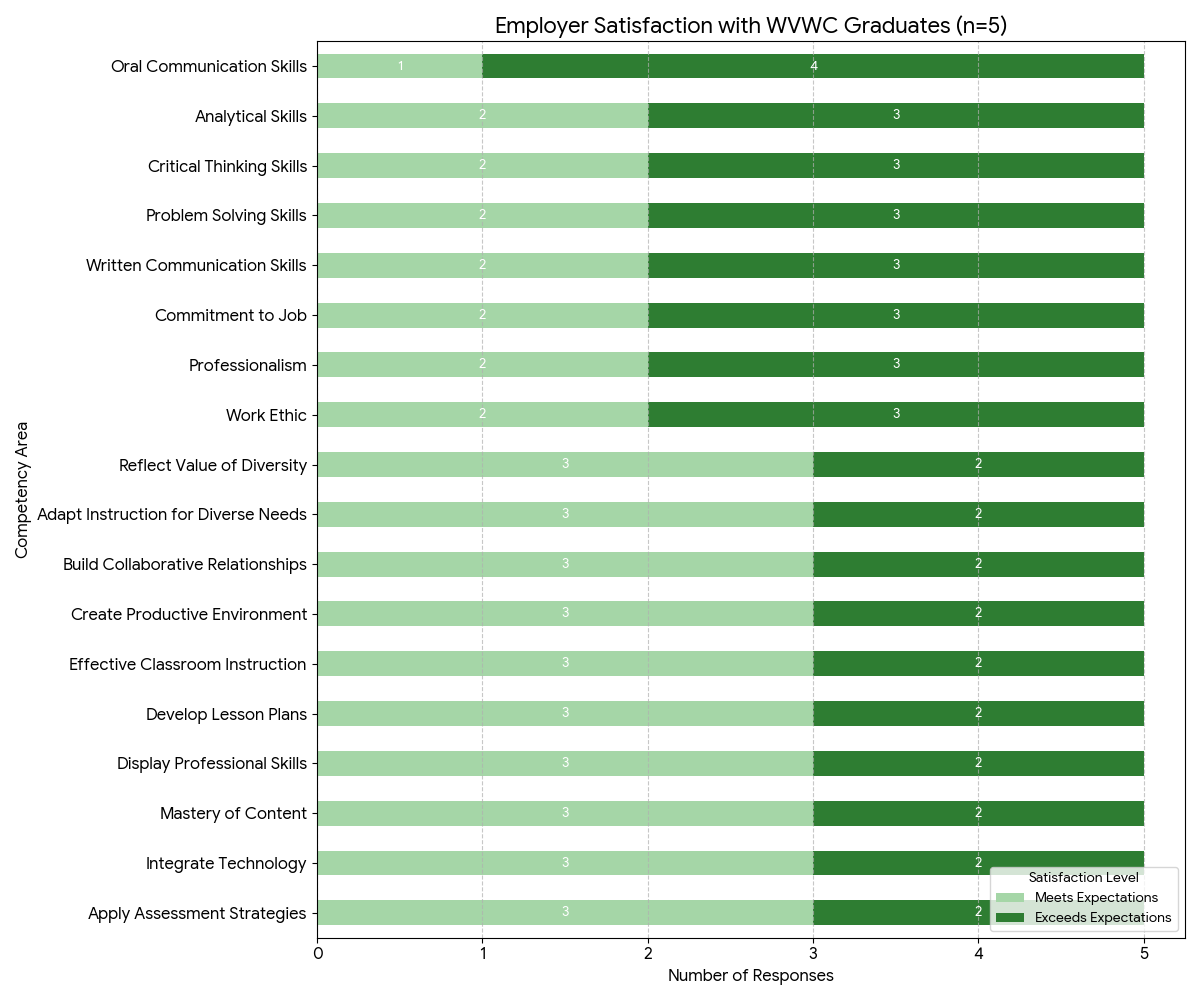
WV Wesleyan is committed to continuous improvement through meaningful collaboration with our PK-12 partners. CAEP Measure 2 focuses on how well our graduates meet the needs of their employers and how effectively we engage our stakeholders in the program’s evaluation and development. To provide a comprehensive view of our program’s impact, we utilize a multi-faceted assessment approach.
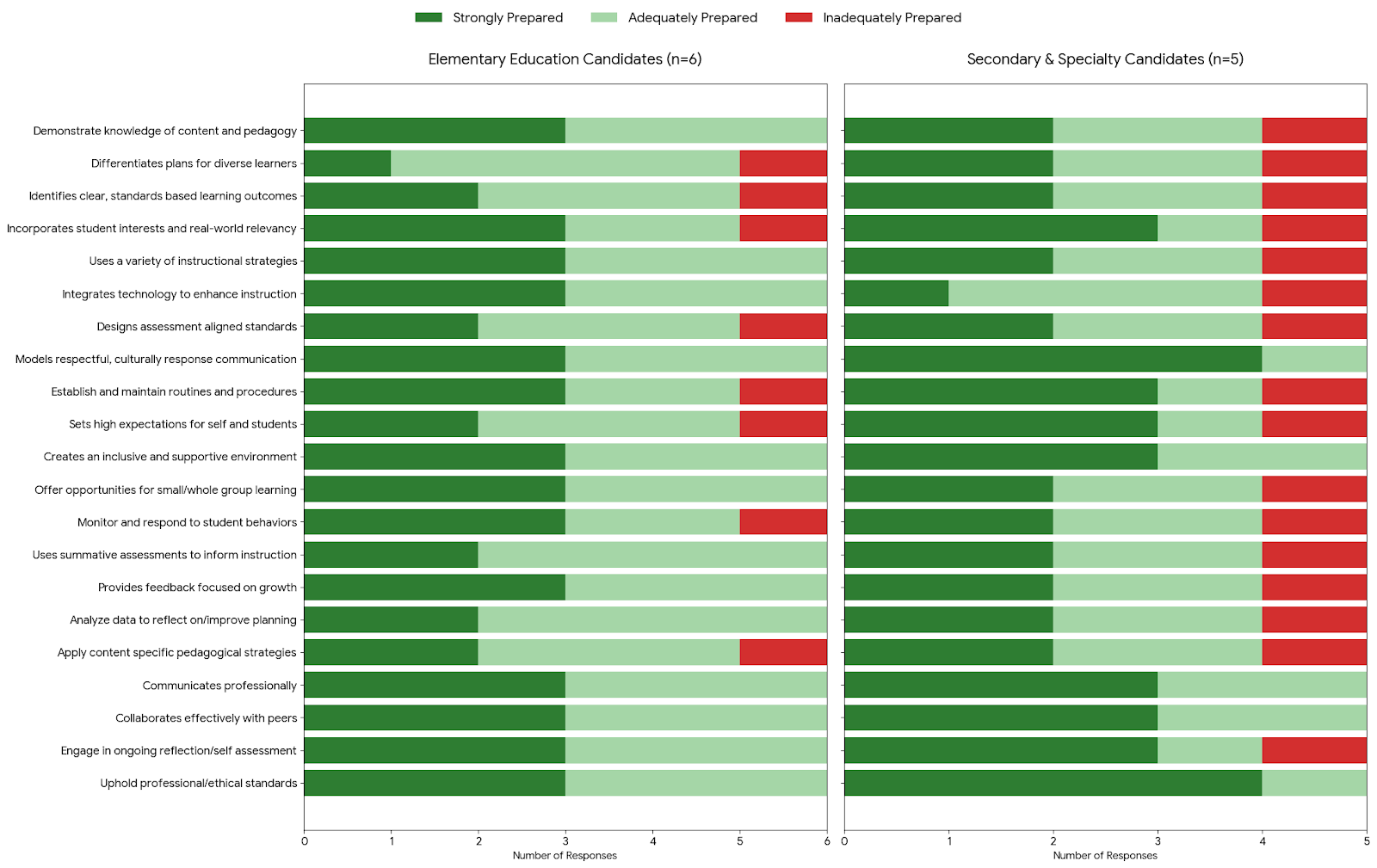
Based on the CAEP response from the Spring 2025 site visit, the EPP is reporting on new surveys and data captured during the Fall 2025-Spring 2026 academic year. We have utilized a multi-layer assessment approach to evaluate the satisfaction of our employers and stakeholder involvements. We include Educator Preparation Program Advisory Council (EPPAC) minutes from December 2, 2024 to present to document the continuous dialogue between the program and our PK-12 partners, ensuring that stakeholders have a direct voice in program governance and clinical design. The Completer Survey and Employer Survey capture the transition from candidate to professional. Finally, we include the Mentor Teacher Feedback Survey as a critical data point. While we are unable to disaggregate some of the data due to a small number of participants (n), it provides us a snapshot of information.
b. EPPAC Minutes
c. Completer Survey (Survey had less than 10 responses-not able to disaggregate)
Narrative for Completer survey
d. Employer Survey
Narrative for Employer Satisfaction
e. Cooperating Teacher Feedback Survey
Narrative for Cooperating Teacher Survey
3. Measure 3 Candidate Competency at Program Completion CAEP R3.3
a. Praxis II Scores: Initial Level Praxis II Completer Pass Rate Report
i. The Praxis II is required for licensure in WV.
b. WV Teacher Performance Assessment (WVTPA) Results
i. The WV Teacher Performance Assessment (WVTPA) requires that teacher candidates draw on pedagogical and content pedagogical knowledge to plan and deliver instruction that builds on each student’s strengths, needs, and prior experiences.
4. Measure 4 Ability of Completers to be Hired
The table below provides employment rates of our completers from 2022-2025. The program goal is that all completers will be employed in their licensure area or enrolled in graduate school within six months following graduation. Due to the number of overall completers, we are unable to disaggregate the data by program.
Table: Measure 4: Ability of Completers to be Hired
Academic Year # of Completers # of Employed # of Graduate School Unknown 2024-2025 4 3 1 0 2023-2024 12 8 0 4 2023-2022 16 13 0 3
Dr. Ashley Martucci, Director, Associate Professor
B.S., West Virginia University
M.Ed., James Madison University
Ed.D., West Virginia University
Email: martucci.a@wvwc.edu
Dr. J. Scott Biola, Assistant Professor
BA, Interdisciplinary Studies/Social Studies, West Virginia University
M.A., Secondary Education, West Virginia University
Ed.D., Curriculum & Instruction, University of Virginia
Email: biola.j@wvwc.edu
Dr. Tammy Samples, Associate Professor
B.A., West Virginia University
M.Ed., Marshall University
M.Ed., Marshall University
Ed.D., West Virginia University
Area of Instruction: Education
Email: samples_t@wvwc.edu
Phone: 304-473-8142
Dr. Michael Mendicino, Assistant Professor
M.S., California University of Pennsylvania
Ed.D., West Virginia University
Area of Instruction: Special Education
Email: mendicino_m@wvwc.edu
Phone: 304-473-8345
Vicki Sharp, Director of Clinical Experiences
Email: sharp.v@wvwc.edu
Phone: 304-473-8048
Dr. Shirley Fortney, Emeriti Faculty
Area of Instruction: Special Education
Email: fortney@wvwc.edu
Phone: 304-473-8107
Dr. Karen R. Petitto, Emeriti Faculty
Area of Instruction: Technology Education
Email: petitto@wvwc.edu
-
Elementary Education (K-6)
Students will:
- Incorporate technology and 21st century knowledge, skills, and techniques into instructional strategies to promote higher-level student learning.
- Design and implement a variety of instructional strategies that promote learning experiences connected to students’ diversity in culture, gender, disability, linguistics, and family differences
- Synthesize and apply the various learning theories of behaviorism, cognitivism, and constructivism to facilitate the learning of diverse students.
- Apply decision-making skills to the analysis of the curriculum and modifications necessary to meet individual learner needs and comply with legal and policy requirements.
- Apply subject matter pedagogy and ability to design instructional experiences that promote creativity innovation, and problem solving.
- Demonstrate an ability to prepare and apply balanced assessment and to use assessment results to modify instruction.
- Demonstrate the knowledge, skills, and dispositions appropriate for meeting state standards and content specialization standards expected for professional teaching candidates.
-
Music Education (PreK-Adult)
Students will:
- Incorporate technology and 21st century knowledge, skills, and techniques into instructional strategies to promote higher-level student learning.
- Design and implement a variety of instructional strategies that promote learning experiences connected to students’ diversity in culture, gender, disability, linguistics, and family differences
- Synthesize and apply the various learning theories of behaviorism, cognitivism, and constructivism to facilitate the learning of diverse students.
- Apply decision-making skills to the analysis of the curriculum and modifications necessary to meet individual learner needs and comply with legal and policy requirements.
- Apply subject matter pedagogy and ability to design instructional experiences that promote creativity innovation, and problem solving.
- Demonstrate an ability to prepare and apply balanced assessment and to use assessment results to modify instruction.
- Demonstrate the knowledge, skills, and dispositions appropriate for meeting state standards and content specialization standards expected for professional teaching candidates.
-
English Education (5-Adult)
Students will:
- Incorporate technology and 21st century knowledge, skills, and techniques into instructional strategies to promote higher-level student learning.
- Design and implement a variety of instructional strategies that promote learning experiences connected to students’ diversity in culture, gender, disability, linguistics, and family differences
- Synthesize and apply the various learning theories of behaviorism, cognitivism, and constructivism to facilitate the learning of diverse students.
- Apply decision-making skills to the analysis of the curriculum and modifications necessary to meet individual learner needs and comply with legal and policy requirements.
- Apply subject matter pedagogy and ability to design instructional experiences that promote creativity innovation, and problem solving.
- Demonstrate an ability to prepare and apply balanced assessment and to use assessment results to modify instruction.
- Demonstrate the knowledge, skills, and dispositions appropriate for meeting state standards and content specialization standards expected for professional teaching candidates.
-
Math Education (5-Adult)
Students will:
- Incorporate technology and 21st century knowledge, skills, and techniques into instructional strategies to promote higher-level student learning.
- Design and implement a variety of instructional strategies that promote learning experiences connected to students’ diversity in culture, gender, disability, linguistics, and family differences
- Synthesize and apply the various learning theories of behaviorism, cognitivism, and constructivism to facilitate the learning of diverse students.
- Apply decision-making skills to the analysis of the curriculum and modifications necessary to meet individual learner needs and comply with legal and policy requirements.
- Apply subject matter pedagogy and ability to design instructional experiences that promote creativity innovation, and problem solving.
- Demonstrate an ability to prepare and apply balanced assessment and to use assessment results to modify instruction.
- Demonstrate the knowledge, skills, and dispositions appropriate for meeting state standards and content specialization standards expected for professional teaching candidates.
-
Social Studies Education (5-Adult)
Students will:
- Incorporate technology and 21st century knowledge, skills, and techniques into instructional strategies to promote higher-level student learning.
- Design and implement a variety of instructional strategies that promote learning experiences connected to students’ diversity in culture, gender, disability, linguistics, and family differences
- Synthesize and apply the various learning theories of behaviorism, cognitivism, and constructivism to facilitate the learning of diverse students.
- Apply decision-making skills to the analysis of the curriculum and modifications necessary to meet individual learner needs and comply with legal and policy requirements.
- Apply subject matter pedagogy and ability to design instructional experiences that promote creativity innovation, and problem solving.
- Demonstrate an ability to prepare and apply balanced assessment and to use assessment results to modify instruction.
- Demonstrate the knowledge, skills, and dispositions appropriate for meeting state standards and content specialization standards expected for professional teaching candidates.
-
Special Education (Multicategorical K-12)
Students will:
- Incorporate technology and 21st century knowledge, skills, and techniques into instructional strategies to promote higher-level student learning.
- Design and implement a variety of instructional strategies that promote learning experiences connected to students’ diversity in culture, gender, disability, linguistics, and family differences
- Synthesize and apply the various learning theories of behaviorism, cognitivism, and constructivism to facilitate the learning of diverse students.
- Apply decision-making skills to the analysis of the curriculum and modifications necessary to meet individual learner needs and comply with legal and policy requirements.
- Apply subject matter pedagogy and ability to design instructional experiences that promote creativity innovation, and problem solving.
- Demonstrate an ability to prepare and apply balanced assessment and to use assessment results to modify instruction.
- Demonstrate the knowledge, skills, and dispositions appropriate for meeting state standards and content specialization standards expected for professional teaching candidates.
Programs of Study
-
Art and Design
-
Biology & Environmental Science
-
Business
-
Chemistry & Biochemistry
-
Communication & Media
-
Education

-
English
-
Exercise Science & Athletic Training
-
Health Sciences
-
History and International Studies
-
Mathematics, Computer Science, and Cybersecurity

-
Music

-
Nursing

-
Philosophy and Religious Studies
-
Physics & Engineering
-
Psychology

-
Social Sciences

-
Theatre & Dance Department

-
Art and Design
-
Biology & Environmental Science
-
Business
-
Chemistry & Biochemistry
-
Communication & Media
-
Education
-
English
-
Exercise Science & Athletic Training
-
Health Sciences
-
History and International Studies
-
Mathematics, Computer Science, and Cybersecurity
-
Music
-
Nursing
-
Philosophy and Religious Studies
-
Physics & Engineering
-
Psychology
-
Social Sciences
-
Theatre & Dance Department